
Pokhara did not have to try very hard to become famous. The Annapurna range, containing three of the ten highest peaks on the planet, arranged itself within 25 kilometres of the city long before the city existed. Phewa Lake appeared, still and enormous, at its doorstep. The sacred peak of Machhapuchhre rose at such an angle that its reflection in the lake became, for visiting photographers, something close to an obligation. Pokhara’s role was simply not to ruin it.
It has found this role challenging.
The lake that made Pokhara has been shrinking for the better part of six decades. In 1962, Phewa Lake covered 10.35 square kilometres. Today, it covers approximately 4. The causes are not obscure: siltation from streams, urban runoff, sewage, and the steady encroachment of hotels, resorts, and restaurants built in flagrant disregard of protection orders that date to 1973. A government gazette notification issued that year designated a 200-foot exclusion zone around the lake’s perimeter. The notification has been in continuous violation ever since.
The Supreme Court intervened in 2018. It intervened again in June 2023, this time with a 30-page judgment ordering the removal of all structures within 65 metres of the high-flood line, to be completed within six months. Unsurprisingly, the structures are still there.
Demarcation work — the erecting of boundary pillars to mark where the illegal structures begin — commenced in May 2025, roughly two years after the order and, notably, shortly after the Prime Minister placed a personal phone call to Mayor Dhana Raj Acharya to inquire about progress. By the mayor’s own account, 1,055 pillars have now been installed. They mark, with some precision, the scale of the problem they have not yet addressed.
The lake is a Ramsar-listed wetland. It accumulates more than 142,000 tonnes of sediment annually. Its aquatic life has largely vanished. The migratory birds have declined. It remains, for the time being, the primary reason tourists come to Pokhara — a fact that features prominently in the city’s promotional literature and somewhat less prominently in its enforcement record.
Pokhara’s international airport opened on January 1, 2023. It was built with a $216 million loan from China’s Export-Import Bank, awarded to China CAMC Engineering, and was projected, on the basis of a feasibility study commissioned by the contractor, to carry 280,000 international passengers per year from 2025 onwards, generating enough revenue to service its own debt.
Annual repayments on the loan amount to roughly $19.8 million. Annual revenues from airport operations, however, hovers below $1 million. The airport’s runway, at 2,500 metres, cannot accommodate long-haul wide-body aircraft. There are no cargo or maintenance facilities. India has not granted western approach routes to its carriers, a constraint that was known before the loan was signed and which eliminates the most obvious source of regional traffic. Government incentives — fee waivers, 75% discounts on ground handling — have not produced scheduled services.
In August 2024, Nepal formally requested that China convert the loan into a grant. China declined. In December 2025, Nepal’s anti-corruption commission filed charges against 55 individuals and the Chinese construction firm over procurement irregularities. The airport continues to operate predominantly domestic flights, servicing a debt load that its revenues, under optimistic projections, will not cover within the loan’s repayment window.
The city generates 182 tonnes of waste daily, according to a World Bank study. Its existing landfill, a temporary facility, reached full capacity in early 2026. Garbage collection across the city stopped. Waste accumulated on roadsides, at junctions, in residential areas. The metropolitan authority dug pits in public land as an interim measure and issued a request to residents to refrain from discarding household waste in the streets for “a few days.”
The new landfill, designed to handle 250 tonnes per day, announced in November 2024, described by the mayor at a UN Development Programme event as central to Pokhara’s ambitions as a zero-waste city, has not yet been built. Its site has not yet been identified, owing, the metropolitan authority notes, to limited land availability in Pokhara.
The city has been the official tourism capital of Nepal since 2024. It produces more waste each day than the landfill it has been planning to build would handle. The landfill does not yet have a location.
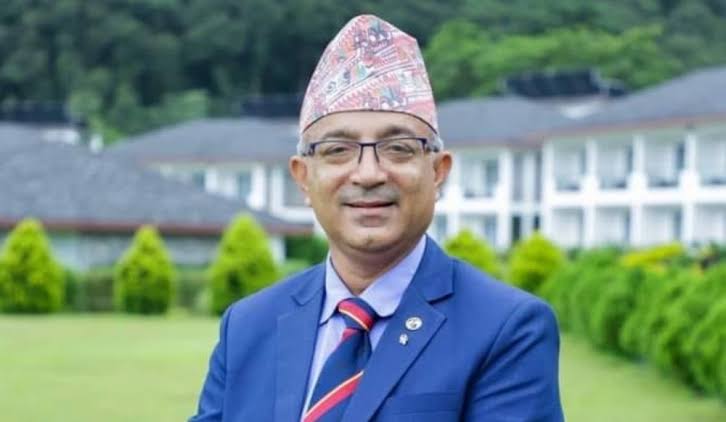
Mayor Acharya took office in May 2022 with three decisions. He would seek the government’s formal designation of Pokhara as the tourism capital of Nepal. He would provide nutrition allowances to children from impoverished families. And he would commission proposals for a “Pokhara Memorial”, a three-dimensional monument celebrating the city’s identity, with a cash prize of Rs 200,000 for the winning design.
The tourism capital designation arrived in 2024. The monument has not been built. The lake is smaller than when he took office. The airport’s debt is larger. The landfill is still a concept.
The gap between what Pokhara’s administration announces and what it delivers is not, at this point, a matter of conjecture. It is a matter of record. Supreme Court orders go unimplemented for years. Infrastructure projects open without the conditions required for them to function. Environmental crises unfold in slow motion while committees are formed to study them. The city’s natural beauty — the thing upon which its entire economy depends — is treated less as an asset to be managed than as a backdrop to be photographed.
One is tempted to conclude that Pokhara’s administrators are actively hostile to the city’s interests. The evidence does not quite support this. What it supports is something more mundane: that the declaration of intent has come, over time, to substitute for its execution.
The Annapurnas, indifferent to municipal planning cycles, continue to rise above the valley. The lake continues to reflect them, in less water than before, for tourists who arrive having seen photographs taken when it was larger. The city continues to market itself, with some success, on the strength of what it has not yet managed to destroy.
It is, all things considered, a remarkable achievement. The question of how long it can continue is one that Pokhara’s governance has not, as yet, been asked to answer.

 THE NEPALI
Leave a comment