
There is a useful distinction, borrowed from the British newspaper Financial Times, between a newspaper and a bulletin board. A newspaper challenges its readers. A bulletin board tells them what they already believe. The FT has long maintained that its job is to follow the evidence wherever it leads, on free trade, on capital markets, on the limits of state capacity, even when that evidence irritates its own subscribers. That willingness to be unpopular with its own audience is precisely what gives it authority.
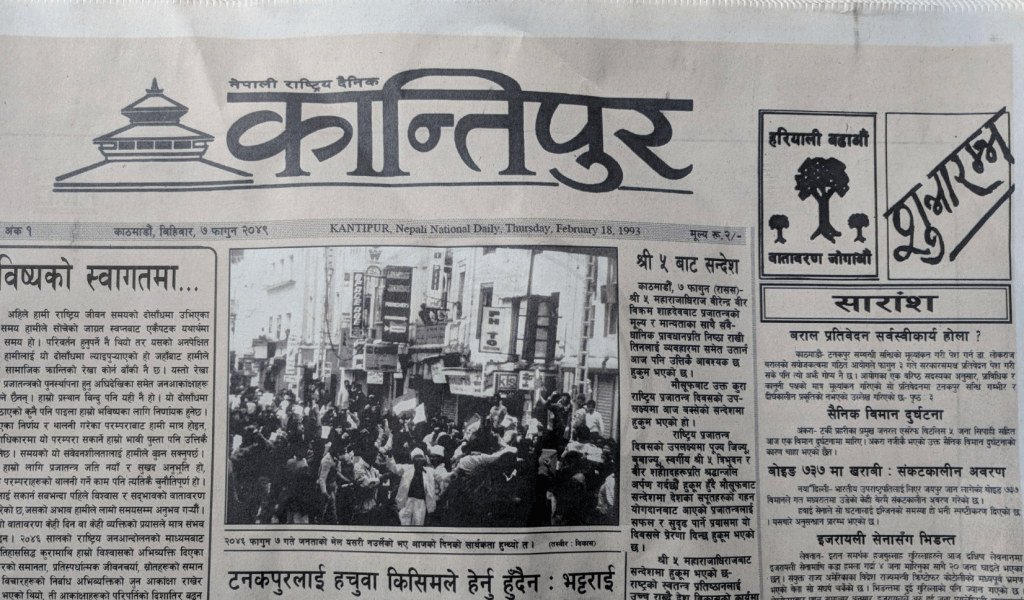
By that standard, Kantipur‚ Nepal’s most-read daily, and the newspaper-of-record, has been drifting toward the bulletin board end of the spectrum. Founded in 1993, it emerged in the early years of Nepal’s democratic opening as something the country had rarely possessed. A professionally run, commercially independent press organisation with genuine national reach.
The paper has real achievements to its name, and they deserve acknowledgment before the criticism begins. Kantipur’s investigative work, on cooperative sector fraud, on procurement corruption, on political nexus and illegal land transactions, has been genuinely important. Its disaster and conflict reporting has taken journalists to places most Kathmandu media avoids. It has confronted prime ministers and, on occasion, paid a price for doing so. That record is not nothing. It is, in fact, the foundation on which the paper’s credibility rests.
But foundations require maintenance. And Kantipur’s has been quietly undermined by a decade of editorial choices that have made the paper increasingly comfortable, increasingly predictable, and decreasingly useful to anyone who doesn’t already share the assumptions of Kathmandu’s educated left.
Nothing illustrates the pattern more clearly than Kantipur’s coverage of the Millennium Challenge Corporation compact, the $500 million US grant for roads and electricity transmission that spent years paralysed in political controversy before Parliament finally ratified it in February 2022.
The compact was contentious. Questions about Nepal’s sovereignty, its geopolitical position between India and China, and its development priorities were all legitimate subjects for journalistic scrutiny. But Kantipur’s coverage tilted. The framing of MCC as a potential American strategic intrusion, with Kantipur columns and news analysis repeatedly giving oxygen to the “Indo-Pacific Strategy trap” narrative, did not emerge in a vacuum. It reflected a broader editorial reflex: instinctive suspicion of Western capital and American intent, combined with a conspicuous reluctance to examine with equal rigour the interests of the parties stoking anti-MCC sentiment, including China’s well-documented disinformation campaign against the compact.
The paper’s eventual editorial position, published after ratification, was sensible enough, it acknowledged the compact’s value and the damage caused by years of delay. But the path to that position had been anything but straight. The accumulated coverage gave far more column inches and credibility to opponents of the grant than to those making the economic case for it. A $500 million infrastructure gift, the sort of thing that small developing economies dream of, was treated by Nepal’s leading newspaper with more editorial suspicion than a Belt and Road initiative that came with loans, conditions, and strategic strings of its own.
This is not about being pro-American. It is about consistency. Apply the same scrutiny to all sources of foreign capital and all geopolitical interests, or apply it to none. Kantipur applied it selectively.
Kantipur’s economic coverage suffers from a related asymmetry. Nepal has, for thirty years, chronically underperformed its potential. Its young people leave to Qatar, to Malaysia, to wherever someone will hire them, in numbers that represent one of the highest emigration rates in Asia relative to population. Remittances now constitute roughly a quarter of GDP, which means the economy is substantially kept alive by people who have given up on finding opportunity at home.
The reasons for this are not mysterious. Nepal’s regulatory environment is punishing for small businesses. Its energy sector, despite sitting atop one of the great hydropower resources on the planet, 83,000 MW of technical potential, barely 3,000 MW developed, has been strangled by the intersection of political interest and state control. Foreign investors who want to build power projects face a legal framework that, as one analysis noted, is still governed by an Electricity Act dating from 1992.
Kantipur covers these symptoms diligently. It reports on youth unemployment, on the remittance economy, on power cuts, on the failures of public enterprise. What it covers far less seriously are the structural arguments about why these problems persist and what would actually fix them. The proposition that Nepal needs less state intervention in its economy, not more, that deregulation, private capital, and competitive markets are the primary engines through which comparable countries have climbed out of poverty, is not a fringe position. It is the consensus finding of development economics over the past forty years, from Bangladesh’s garment sector to Vietnam’s export transformation to India’s post-1991 growth surge.
That argument deserves serious, regular engagement in Nepal’s leading newspaper. It does not get it. The economic vocabulary of Kantipur’s opinion section, “exploitation,” “neo-liberal agenda,” “corporate capture”, signals before the analysis begins which conclusions are acceptable.
The opinion section is where a newspaper’s soul is most visible, and Kantipur’s soul is predominantly left. That is not an accusation, it is a description. The question is whether the paper has been honest with itself, and its readers, about it.
Khagendra Sangraula, a veteran socialist writer and one of Kantipur’s most prominent columnists, is a genuine literary intellectual whose moral seriousness commands respect. His writing on caste, on political culture, on the responsibilities of the Nepali intelligentsia has been important. But Sangraula’s framework is explicitly Marxist, and his columns proceed from assumptions, about the primacy of class struggle, about the inherent suspiciousness of private capital, that represent one tradition of political thought, not the only serious one. When Kantipur features him without counterweight, it is not presenting a debate; it is presenting a tradition.
CK Lal is a more complex case. Writing across Kantipur and the Kathmandu Post, Lal is probably the most intellectually distinguished analyst the Nepali press has produced, erudite, historically informed, capable of genuine insight into Nepal’s governance pathologies. His diagnosis that Nepal’s political culture remains shaped by a “power-centric mindset” rooted in Prithvi Narayan Shah and the Rana era is historically grounded and worth taking seriously. But Lal’s columns on economic questions skew heavily toward statist solutions, and his occasional forays into geopolitics reflect a worldview in which Western capital and American power are treated as presumptively suspect in ways that China’s capital and power are not subjected to symmetrically. His is a valuable voice. It is not a sufficient voice, and Kantipur treats it as close to definitive.
Ahuti, Bishwa Bhakta Dulal, is a Dalit intellectual and former Maoist constituent assembly member whose work on caste and class is another important voice. His argument that Dalit liberation requires a classless society is a sincere position held by a serious thinker who has lived the consequences of caste discrimination in ways that most opinion editors have not. It belongs in the paper. What also belongs in the paper, and is largely absent, is the counter-argument: that economic freedom and property rights, not class struggle, have done more to lift marginalised communities out of poverty in the countries where they have been seriously tried; that the communist parties to which Ahuti devoted decades have demonstrably failed Nepal’s Dalits despite their rhetoric; that Ambedkar’s critique of both caste Hinduism and Marxist economic organisation is as relevant to Nepal as to India.
Those counter-arguments exist. Serious people hold them. Kantipur does not give them a home. The pattern that emerges from the columns page is not a conspiracy. It is something more banal and more durable, it is an editorial culture so internally consistent that it has stopped noticing its own shape. If you have read Sangraula, Lal, and Ahuti for a decade, the assumptions they share start to feel like the assumptions of reality itself. Other assumptions, about markets, about the limits of the state, about individual economic freedom, start to feel like ideology requiring special justification.
Sambhav Sirohiya, who now runs Kantipur Media Group, has navigated the structural crisis of print journalism in a poor country with more competence than most. The group’s digital transition has been real. The Kantipur Conclave, which he chairs, brings international voices and genuine intellectual ambition to Kathmandu. When his father Kailash Sirohiya opened this year’s conclave by arguing that “a conscious society is built on accurate information, debate and dialogue,” he was articulating a principle that Kantipur has the scale to embody but currently falls short of.
Nepal is a country that has been governed, in various forms, by state-heavy politics for most of its modern history, by monarchy, by the Panchayat system, and since 1990 by a democratic politics dominated by parties whose intellectual formation is Marxist even when their practice is anything but. The results are visible in every emigration statistic, every power-cut bulletin, every ranking of ease of doing business in which Nepal sits at bottom of South Asia.
A newspaper that takes this record seriously should be running a sustained, open, intellectually honest interrogation of those assumptions, not to replace one orthodoxy with another, but because the country’s development challenges are too serious for its leading media institution to be running a seminar in one school of political thought.
The Financial Time’s longstanding principle, that markets, properly regulated, remain the most effective mechanism humanity has found for generating broad prosperity, is not ideological dogma. It is an empirical claim, contested in its details but supported by the weight of development experience across four decades and dozens of countries. Kantipur’s editorial board should engage with that claim seriously: test it against Nepal’s context, push back where the evidence demands it, but not dismiss it before the argument is made.
Kantipur was built on the proposition that Nepali readers deserved a serious newspaper. They still do. Giving them one, a paper that trusts them with the full complexity of public argument, including arguments that challenge the paper’s own editorial instincts, is not a commercial risk. It is the only sustainable foundation for the authority that Kantipur has spent thirty years trying to build.
That authority is eroding. It can be recovered. But not by publishing, week after week, the same conversation Nepal’s educated left is already having with itself.


 THE NEPALI
Leave a comment