

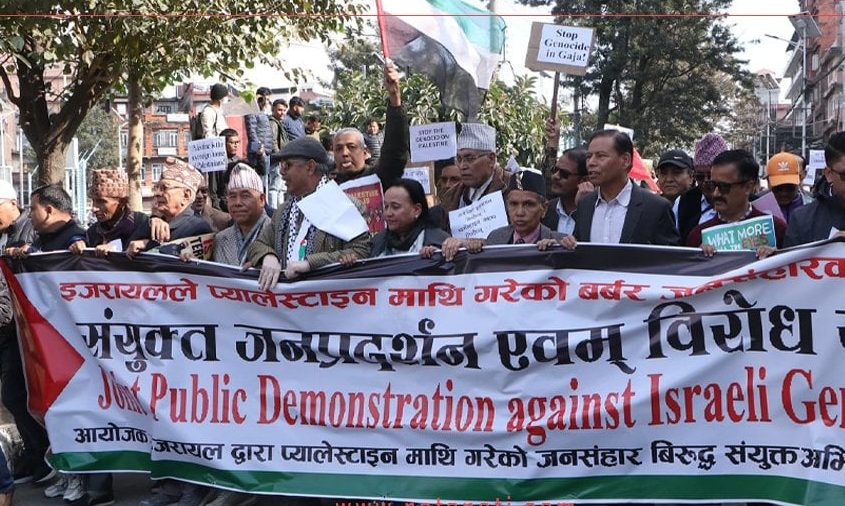
There is a particular kind of modern activism that mistakes the performance of outrage for the substance of it, that confuses the emotional intensity of a gesture with the moral seriousness of a cause. We see it in the world’s most photographed protest movements.
The point of such activism is never really the cause itself. The cause is the currency with which the activist purchases their identity, where outrage becomes a credential and grief an aesthetic content. The slogan exists not to demand change but to announce the speaker’s virtue to whoever is watching, and in the age of Instagram, someone is always watching.
Nepal’s so-called GenZ leadership has given us a domestic version of this pathology, and it is time we said so plainly.
On the morning of September 8, 2025, thousands of school students and young professionals gathered at Maitighar Mandala in Kathmandu, many of them in uniform, carrying banners that read “Youth Against Corruption.” The movement had no manifesto, no party colours. Its organisers insisted, repeatedly and explicitly, that it had no leaders, and this was not a weakness of design but its central moral claim.
By early afternoon, police opened live fire on the crowd outside parliament. By September’s end, at least 75 people were dead, the overwhelming majority shot above the waist, in the head, neck, and chest, in what Amnesty International would later call “a shocking and callous disregard for human life.” A 12-year-old child was among those confirmed dead. Over two thousand were injured.
Those deaths were not background noise to a political event. They were the event. They were the price Nepal’s youngest generation paid for the right to demand that the people who governed them be held to account. It is worth sitting with that before examining what followed.
Consider Tanuja Pandey, who turned 25 four days after September 8, and who by that time had already become the “poster girl” of Nepal’s GenZ protests. A lawyer and climate justice activist from Jhapa who had built the @gen.znepal Instagram presence and coined the rallying cry “Enough is Enough”. Pandey had genuine activist credentials going back years. She founded Harin Nepal, an environmental organisation, at nineteen, and had been writing about climate justice long before the September uprising gave her a national platform. One would be churlish to deny any of that.
But here is what else is true, and what Pandey would rather you not examine too closely. Multiple reports indicate she was associated with the youth wing of the Nepali Congress, the very party whose coalition with KP Sharma Oli’s government had made it an accomplice in the conditions that produced the uprising, and whose headquarters were burned by protesters in September for precisely that reason.
The Nepali Congress was not a bystander to the rot GenZ rose against, it was one of its institutional authors. When Pandey’s critics raised this, she was, by her own account, “crestfallen”, she denied links to the party with some vigour. Her grandfather, Ramesh Nath Pandey, served as Nepal’s Foreign Minister during the royal regime, a connection the family has deep roots in, and reports of her earlier Congress youth-wing association have never been cleanly refuted.
None of this would be disqualifying in itself. What makes it significant is the gap between Pandey’s self-presentation‚ the scrappy, organic, grassroots challenger to the old order‚ and the actual contours of her biography, which places her closer to the political establishment than her brand identity suggests. Pandey has built her public persona entirely on the premise that she represents a clean break from the old way of doing things. The premise is, at best, complicated. At worst, it is another form of the nepo-kid culture, only wrapped in denim and a climate-justice hashtag.
Rakshya Bam is a more interesting case, and in some ways a more troubling one, because the gap between her stated principles and her conduct has been so consistently and specifically documented. Bam, who grew up in Kailali in the far-west and moved to Kathmandu to study, has spoken movingly and often about the systemic neglect of provinces like Sudurpaschim. “Kailali is not poor, it is made poor,” she has said, with a bluntness that commands respect.
She walked out of Army Headquarters in the days after September 9 when the army chief tried to seat GenZ representatives alongside Durga Prasai and the pro-monarchist Rastriya Prajatantra Party, saying the grouping would undermine the movement’s credibility. In the aftermath of protests, she told the press without ambiguity that her GenZ friends risked their lives and were shot in the chest and head while shouting slogans for good governance and against nepotism and cronyism, nothing else.
These are the words of someone who appears to understand exactly what is at stake. They are also, it turns out, words that do not constrain her own behaviour. By December 2025, Bam had accepted an invitation to private political negotiations at the Kupandol home of then-Kathmandu’s mayor Balen Shah’s close aide, negotiations in which she was specifically tasked, according to Setopati’s reporting, with coordinating which GenZ figures would join Shah-affiliated Desh Bikash Party, and with holding discussions with martyrs’ families on behalf of Shah’s electoral project.
To be precise about what this means: the families of people who were shot dead by the state were being approached, through Bam’s coordination, as potential assets in an electoral strategy. The Nepali Congress, the party that co-authored the coalition government whose police opened fire on those families’ children, was by January 2026 proposing that Bam herself contest from Kathmandu-1 on their ticket, a proposal whose significance should not be lost on anyone.
The party whose headquarters was burned by GenZ protesters in September was, months later, hoping to recruit GenZ’s most prominent coordinator as its candidate. Bam declined. But the fact that the conversation happened at all, that she was a participant in it rather than someone who refused the meeting outright and said so publicly‚ tells you something about the distance she had already travelled from the movement’s founding logic.
Bam has also said, with an apparent sincerity that “some of us should stay outside so we can keep reminding and challenging the people who come to power.” She said this while, by all available evidence, manoeuvring inside the political architecture. Reports suggest she was a trusted aide to Home Minister Om Prakash Aryal of the interim government. The problem is not the access. The problem is that she apparently saw no contradiction between holding it and continuing to perform opposition for an audience that did not know she had it. Bam, so far, has not denied the reports.
Majid Ansari presents a third variation of the same disease. A law student from Morang, the son of a woman who once watched a court officer extort a Musahar villager and who resolved from that moment to use the law as an instrument of justice, Ansari has been more consistent than either Pandey or Bam in his actual advocacy, calling out the Attorney General over the Hope Fertility case, raising questions about the rights of Madhesi and Muslim students, warning against electoral delay with genuine constitutional seriousness. These things matter.
But Ansari arrived at September 8 as an ordinary law student who joined the protest on that day, watched the crowd grow, escaped through Thapagaun when the gunshots began, and went to Civil Hospital to donate blood. This is not the biography of a movement leader. This is the biography of a citizen who showed up for his country at a critical moment, as hundreds of thousands of others did.
The difference is that Ansari, unlike most of those hundreds of thousands, understood very quickly how to monetise‚ in terms of visibility and platform, the GenZ identity that the movement had made valuable. He was soon being quoted on constitutional matters, and he started issuing public statements demanding the dismissal of the Attorney General, and began advising the nation on how to conduct its democracy.
This would be admirable if Ansari had some formal institutional relationship to the movement he was representing. He does not. The movement said it had no leaders. Ansari simply became one by insisting, repeatedly and publicly, that he was one, and by understanding that in the media ecosystem that surrounds a successful uprising, a confident voice with the right vocabulary and the right background story is indistinguishable from an actual representative.
This is not a personal failing peculiar to Ansari. It is a structural feature of how leaderless movements get captured. The movement’s great strength, the absence of a named leadership, becomes its greatest vulnerability once the streets go quiet, because the name-shaped void gets filled by whoever shows up consistently in front of cameras.
What connects all three of them, and what connects Nepal’s GenZ leadership more broadly, is the philosophy of activism as performance. The slogan “Don’t Forget the Blood of Martyrs” was chanted in the streets of Kathmandu by such activists as early as September 9, and it has since appeared on banners, been invoked in press releases, and referenced in speeches with a frequency that should make anyone who actually cares about those martyrs feel something close to revulsion. Not because the sentiment is insincere, but because sincerity, by itself, is not accountability.
As of the time of writing, the commission set up to investigate protest deaths has not released its findings. The people who ordered those 2,642 live bullets, the police logs confirmed that number, have not faced court. The families of the martyrs received 10 lakh rupees each in compensation and a declaration from the interim government that their children were martyrs, which is the kind of gesture that soothes a news cycle without disturbing a power structure. Our self-declared GenZ voices issued suitably outraged statements at appropriate intervals. None of them has made this their consuming, daily, non-negotiable campaign in the way that justice for the dead actually requires.
Meanwhile, at least 49 GenZ-affiliated groups had registered at the Office of the Prime Minister and Council of Ministers by December 2025, according to reports. Most were led by prominent faces of the protest movement itself. The political economy of the martyrs had, within three months, been converted into a registration drive.
This is a specific kind of dishonesty that is more dangerous than ordinary hypocrisy, because it is indistinguishable from genuine conviction on the surface. Tanuja Pandey wrote, in reference to someone else, that “history never forgives traitors who turn the people’s hope, pain and sacrifice into a game of self-interest.” Rakshya Bam, in the same breath as accepting a political brokerage role, said the new forces must not forget “the essence of the GenZ revolution.” Majid Ansari tells young Nepalis to question leaders rather than idolise them, while allowing himself to be idolised as a leader. None of these people, I suspect, believe they are being hypocritical.
This is the endpoint of activism-as-performance, the final stage in which the performer can no longer tell the difference between what they are saying and what they are doing, because the saying has become, for them, a form of doing. This happens everywhere. Greta Thunberg, a popular young Swedish climate activist, once refused to fly to climate conferences, and crossed the Atlantic by sail to honour her stated convictions. But recently, she crossed the Mediterranean twice on diesel vessels to participate in political theatre. The distance between who she was and who she became was not measured in kilometres but in the slow erosion of the distinction between gesture and action. Nepal’s GenZ leaders have travelled a similar distance in considerably less time.
The movement of September 2025 was, in the strictest sense of the word, heroic. It was heroic because it was leaderless, because it was waged by people in school uniforms who had nothing to gain and everything to lose, because it refused the logic that change requires a saviour, and because it paid a price, in blood, in real blood, on real streets, that no amount of subsequent Instagram content can retrospectively justify or redeem.
The 75 people who died did not die so that Tanuja Pandey could become a commentator, or so that Rakshya Bam could be courted by the Nepali Congress as a candidate, or so that Majid Ansari could be quoted as a constitutional authority. They died because they believed, with the desperate and unstrategic conviction of people who have run out of patience, that this country could be better than it has been.
Honouring that belief requires requires the willingness to remain angry past the point where anger is fashionable, past the point where the cameras have moved to the next story, past the point where the political opportunities have been distributed and the movement’s leaders have found their way into the rooms they always, on some level, wanted to be in.
The way of common decency is to pay the price for what you stand for. The martyrs of September 8 paid it fully. The least their self-appointed inheritors can do is stop making speeches about their sacrifice and start earning the right to invoke it. If that is too much to ask, then consider a much smaller request: say nothing. We do not need moral instruction from people who have learned to speak the language of sacrifice while quietly collecting its dividends. The families of the dead do not need elegies. They need justice, and justice, unlike outrage, does not trend.
 THE NEPALI
Leave a comment