
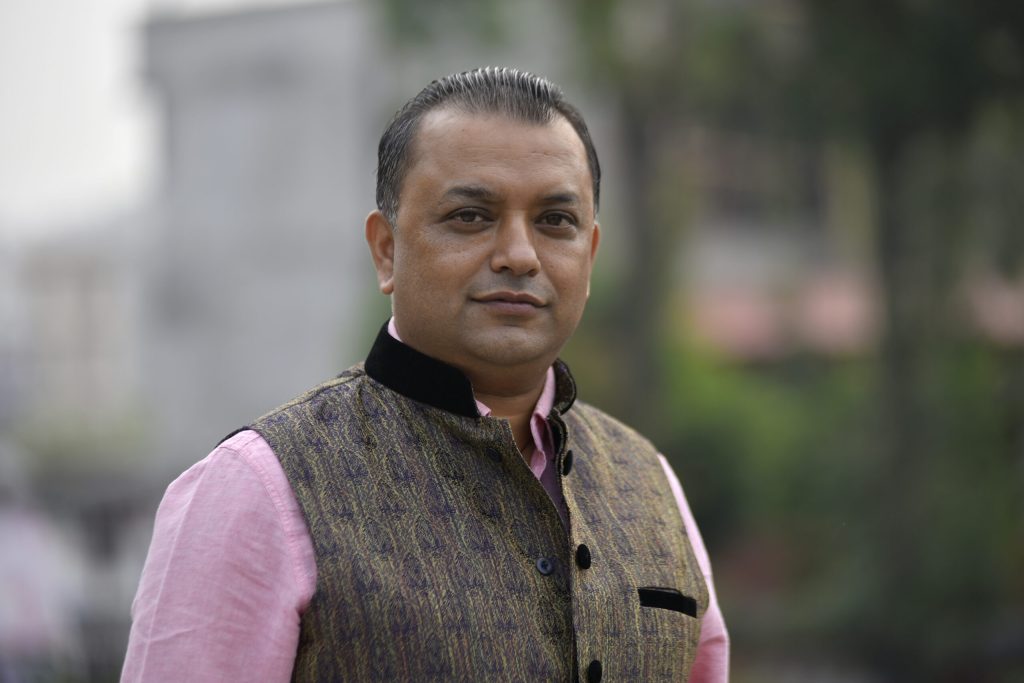
The Nepali Congress was never meant to be the kind of party it has become. Founded in 1947 in the twilight of Rana autocracy, it drew intellectual and moral inspiration from the Indian National Congress but was shaped by Nepal’s own peculiar conditions of a feudal monarchy, a fragmented society and a nascent middle class. Its leading lights, most notably B. P. Koirala, articulated a vision that combined political freedom with social justice, but not at the expense of individual liberty.
Mr. Koirala’s thought is often misread through a modern ideological lens. He spoke of “democratic socialism,” but in practice this meant something closer to European social liberalism than to redistribution. He believed in parliamentary democracy, civil liberties, and a mixed economy in which the private sector would play a leading role. The state, in his view, was a body to correct wrongdoings rather than a dominator of economic life.
In short, the Nepali Congress was born as a liberal party with conservative instincts. Cautious about upheaval, respectful of institutions, and attentive to the realities of a poor, agrarian society. It was a party of reform, not revolution. So how did such a party come to be perceived as indistinguishable from the socialist and even communist forces?
The answer lies partly in Nepal’s turbulent political history. Its early years in power were cut short by King Mahendra’s royal coup in 1960. When democracy returned in 1990, the ideological terrain had shifted. The global Cold War was ending, but Nepal’s domestic politics were increasingly shaped by leftist insurgency, culminating in the Maoist civil war.
Faced with the rise of the Maoists and the Communist Party of Nepal Unified Marxist–Leninist (CPN UML), the Nepali Congress made a fateful choice of convergence rather than differentiation. It embraced populist rhetoric, expanded state commitments, and blurred its economic philosophy. Over time, “democratic socialism” hardened into something more programmatically statist. It gained pace more so in the era of Sher Bahadur Deuba, party’s former leader and five time prime minister.
This was not merely an ideological shift, it was an organisational one. The party became less a vehicle for ideas and more a coalition of factions competing for state resources. Its leaders spoke the language of redistribution while presiding over a system that delivered neither efficiency nor equity. The result was a slow erosion of credibility. To the poor, the party seemed ineffective; to the middle class, it seemed unprincipled; to the young, it became irrelevant.
After it ousted Mr. Deuba and elevated Gagan Thapa as its chairman from the special convention in January this year, the party attempted to position itself as a centrist force. A moderate alternative to both leftist radicalism and conservative reaction. But centrism, when untethered from a clear philosophy, becomes mere opportunism. Mr. Thapa did not realise that. Maybe he did not have enough time?
On economic policy, the party oscillates between promises of welfare expansion and vague commitments to private-sector growth. On governance, it speaks of reform while perpetuating the same networks of patronage. On ideology, it invokes Koirala while ignoring his emphasis on individual freedom and institutional integrity.
This ambiguity might once have been electorally viable. It is no longer.
The general election held on March 5 has upended Nepal’s political order. The Rastriya Swatantra Party (RSP), a party barely a few years old and led by the former journalist Rabi Lamichhane, swept to power in a landslide that few predicted. It secured a commanding majority of 182 seats in the 275-member parliament, while the Nepali Congress was reduced to a distant second with a fraction of that tally.
The scale of the victory is unprecedented. Final counts in most constituencies showed RSP’s candidates far outpaced both the contenders of Congress and the UML. This was not a routine anti-incumbency swing. It was, in the words of observers, a “tsunami”.
The rise of the RSP cannot be understood without reference to the youth-led September protests of 2025, which toppled the UML’s KP Sharla Oli-led coalition government. The demonstration, driven by frustration with corruption, unemployment and political stagnation, created the conditions for a new kind of politics.
RSP positioned itself as the vehicle of that anti-establishment discontent. Most of its members: young, technocratic, and digitally savvy. Its PM-candidate, Balendra Shah, former mayor of capital Kathmandu, cultivated a direct connection with young voters, bypassing traditional party structures and media channels. The result is a generational realignment.
Nepal is a young country—more than 40% of its population is under 35—and this cohort has had enough. And they displayed the youth power in the ballot box quite loudly.
For the Nepali Congress, this is an existential threat. It is no longer competing with the ideological rival, because there are hardly any differences in Congress and RSP’s beliefs. Faced with such a challenge, the temptation for Congress is obvious: to imitate the RSP. To adopt its rhetoric, its style. But that would be a mistake.
The RSP’s appeal lies precisely in its novelty. It is unburdened by history, untainted by governance, and unencumbered by internal factions. Five years in the government is unlikely to turn this upside down. Even if RSP fails to deliver on its promise, the party will have the excuse to sell that it took them five years just to clean the mess left behind by Congress and the Communists.
The Nepali Congress carries the weight of decades in power. It cannot credibly present itself as an outsider. Nor can it outbid the RSP on populism without further eroding its own identity. More importantly, the RSP already occupies the space of reformist activism. If imitation is not the answer, then what is?
The Nepali Congress should return to its roots. It should embrace a coherent ideology that speaks to contemporary realities. That ideology is best described as conservative liberalism. This does not mean a retreat into reactionary politics. It means a commitment to institutional stability, market-led growth, fiscal responsibility, and social pluralism. These principles are not alien to the party’s history. They are, in fact, implicit in the vision of its founders.
Across the world, centrist parties that have survived the populist wave have done so by clarifying — not diluting — their ideological positions. In Europe, for instance, social-democratic parties have embraced market reforms while maintaining a commitment to social protection. In Asia, successful democratic parties have combined economic pragmatism with institutional conservatism.
Nepal’s context is different, but the lesson is similar. Voters reward clarity. It would be a mistake to assume RSP’s success as just a rejection of the old parties. It is a reward for a party that, however loosely defined, offered a distinct narrative. The Nepali Congress, like the CPN UML, currently holds no story to narrate.
For Congress, ideological repositioning is necessary but not sufficient. The party must also address its organisational weaknesses. First, it must renew its leadership. The dominance of ageing elites has long alienated younger voters. Second, it must reform its internal structures. Patronage and factionalism have undermined its effectiveness. Transparent processes for candidate selection and decision-making are essential. Third, it must reconnect with voters. This requires not just better communication, but a willingness to listen, to understand the frustrations that drove millions to support the RSP.
The enormous power has given RSP an opportunity to reshape the country’s political and economic landscape. If it succeeds, even partially, it will likely entrench as the dominant force for decades to come. In such a scenario, the Nepali Congress risks becoming a relic of a bygone era. So, the stakes could not be higher.
Even if the RSP falters, the space it occupies will not automatically revert to Congress. Other challengers will emerge, perhaps more radical, perhaps more disciplined. We saw the rise of the Shram Sanskriti Party, led by former mayor of Dharan, Harka Sampang, in this election. The Nepali Congress still has assets such as nationwide organisation, legacy of democratic struggle, and a reservoir of goodwill among older voters. But these assets are depreciating rapidly.
To arrest the decline, the party must make a choice. It can continue on its current path which is hedging its bets, diluting the message, and hoping for the best. Or it can undertake a more difficult but ultimately more rewarding course of redefining itself as a party of conservative liberalism. Mr. Thapa, or whoever leads the party next, should remember that brands decay long before they die. It is pretty clear that walking in the current path, there is only one destiny for the party.

 THE NEPALI
Leave a comment