
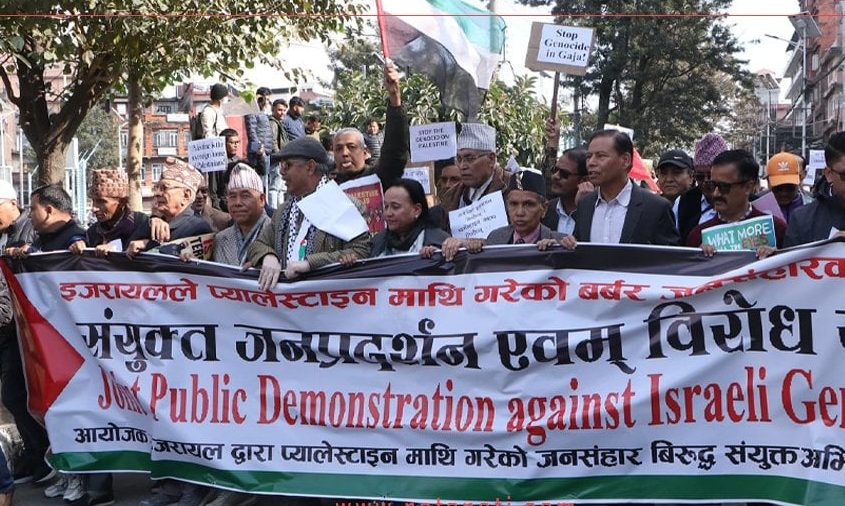
When ten Nepali students were murdered in the Hamas onslaught of 7 October 2023, Kathmandu mourned as any small nation would: funerals, vigils and urgent appeals from a government scrambling to help its nationals caught in a foreign horror. The slaughter at Kibbutz Alumim was not an abstract quarrel between distant states; it was a sequence of scenes that cost Nepali families their sons. Israel’s account and the grim reality on the ground left little doubt about who staged the initial atrocity. Yet in the two years since, public discourse in Nepal among some editors, social-media activists and self-styled intellectuals has at times blurred this sequence, turning moral outrage into a blunt instrument aimed at the wrong target. The result has been a spectacle of solidarity that sometimes looks less like grief and more like ritualised moral performance.
The death, and recent repatriation of Bipin Joshi, one of the Nepalis abducted that day and only now returned after being declared dead, makes this misdirection painfully personal. His family’s vigils and the images of candlelight processions in Kathmandu remind Nepalis of the human costs of geopolitical theatre; they also demand a sober answer to a simple question: whom did this violence begin with, and who has been principally responsible for prolonging it?
Across Western capitals and on social platforms, a new species of activism has gained purchase. Boatyards stage gestures: media-friendly flotillas, short on cargo and long on cameras, which aim less to deliver aid than to create optics of defiance. Celebrity figures who once trafficked in climate righteousness have migrated to the front row of Gaza politics, turning complex, lethal conflicts into tidy moral dramas in which emotion substitutes for judgment. The criticism is not of compassion; it is of a politics that treats feeling as evidence and performance as policy. Such acts may garner applause and headlines, but they do little to help civilians trapped in violent theatres, and worse, they distort causality.
There are two grave errors in the prevailing performative script. The first is historical amnesia: many of the most arresting and misrepresentative slogans recast the Gaza war as a simple tale of occupation and oppression while eliding Hamas’s operational choices, the mass killings and kidnappings that lit the fuse on 7 October and the embedding of arms and fighters amid civilians thereafter. That is not to excuse indiscriminate or excessive military action; civilians have died, and accountable democracies should be held to account when they overstep. But moral clarity requires that criticism begin with facts, not with hashtags.
The second error is moral vanity. Activism that prizes visibility over effect treats suffering as a backdrop for virtue-signalling. Boats that sail with little more than canned goods make for better pictures than HGV convoys of aid routed through established crossings; arrests and deportations make for better copy than the patient slog of negotiation, logistics and reconstruction. If one’s professed aim is the relief of human misery, the metrics ought to be lives saved and supplies delivered rather than likes and retweets.
Nepal’s public sphere – newspapers, activists, and campus intellectuals – ought to be especially careful. Small countries are vulnerable to the seductions of moral simplicity. It is easy to substitute solidarity theatre for sober policy. Doing so risks two injustices at once: the first to the Nepali victims, whose deaths and the fates of whose families deserve clear reckoning with the facts; the second to Palestinians, whose future will not be secured by viral outrage but by political choices that remove the incentives for jihadist rule and create space for governance, reconstruction and normal life.
Practically, this means demanding nuance in coverage, accountability in advocacy, and humility in protest. Editors should insist on reporting that distinguishes between perpetrators and victims; student groups should trade performative marches for informed forums; civil-society leaders should press, loudly and plainly, for the dismantling of armed movements that use civilian suffering as a political tool. Those who genuinely care for Palestinians should be the first to denounce the organisations that keep them mired in violence.
There is also a geopolitical lesson. Last month’s diplomatic manoeuvres of President Donald Trump, which yielded a ceasefire and a partial resumption of aid flows, show the only route out of cycles of violence: tough, patient diplomacy, backed by pressure on the violent actors who profit from chaos.
No serious observer denies that Gaza has suffered immensely. But those who genuinely care for Palestinians must also acknowledge who brought this suffering upon them. Hamas is not a liberation movement, it is a cult of death. Its leaders boasted of the 7 October massacres, promised to repeat them “again and again,” and have treated Palestinian civilians as expendable human props. Every rocket launched from a schoolyard, every weapon stored in a hospital, every tunnel dug beneath a refugee camp exposes Hamas’s cynicism. To pretend otherwise is moral cowardice.
Nepal’s activists claim to champion justice, yet their outrage is selective and their compassion theatrical. They rage at Israel but are mute about the slaughter of Syrians by Assad, the internment of Uyghurs by China, or the killing of Nepalis by Hamas. The anti-Israel frenzy has become less about solidarity and more about identity, a borrowed moral posture imported from the global left and recited without thought.
Hamas remains the villain of this story. It is they who pulled the trigger, who glorified the bloodshed, and who have ensured Gaza’s destruction by embedding war into its very streets. Until Nepali activists can bring themselves to say that aloud, to condemn jihad as fiercely as they condemn Israel, their moral authority will remain as hollow as their chants.

 THE NEPALI
Leave a comment